
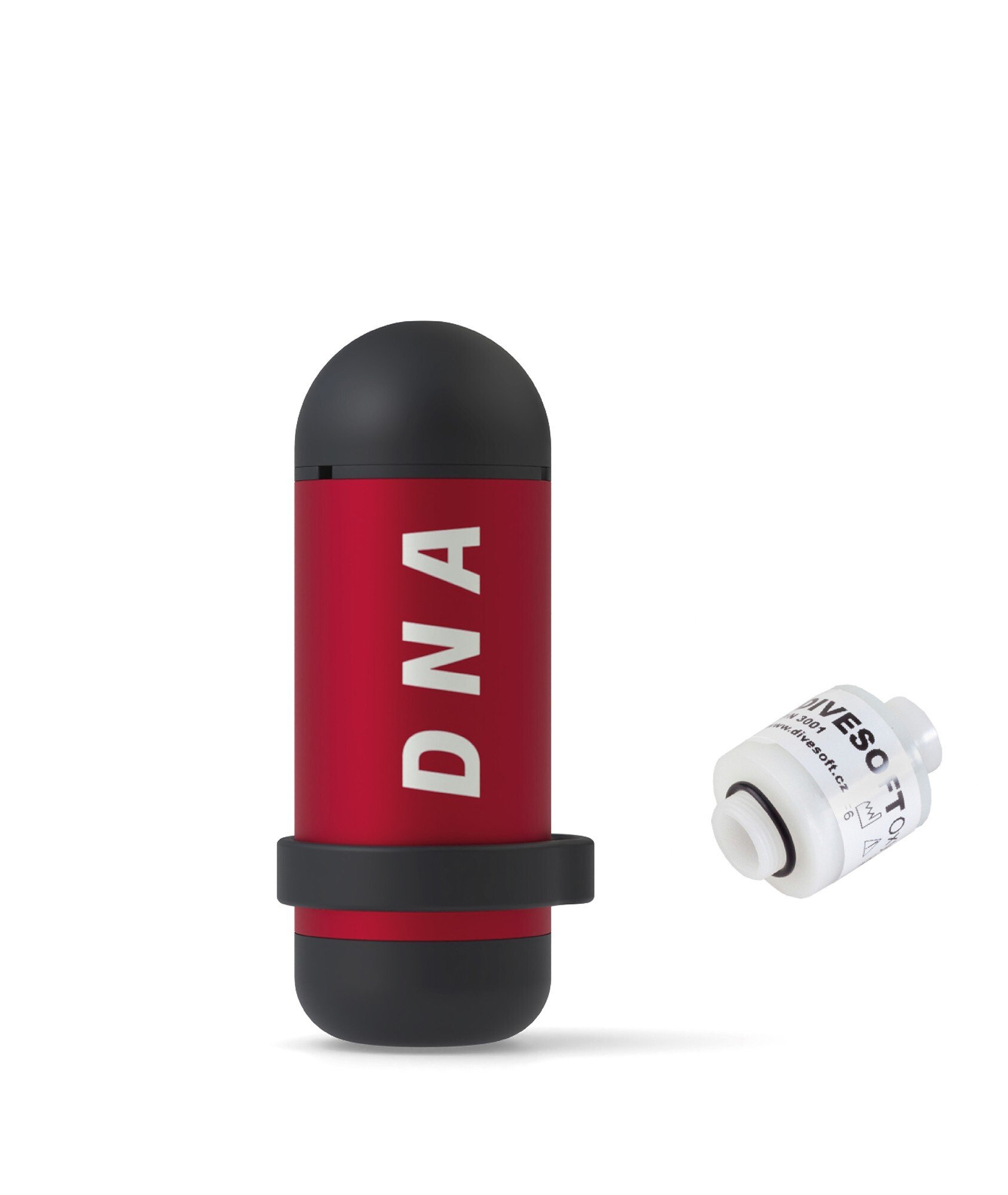
analyzing nitrox,
analyzing nitrox, nitrox analysis
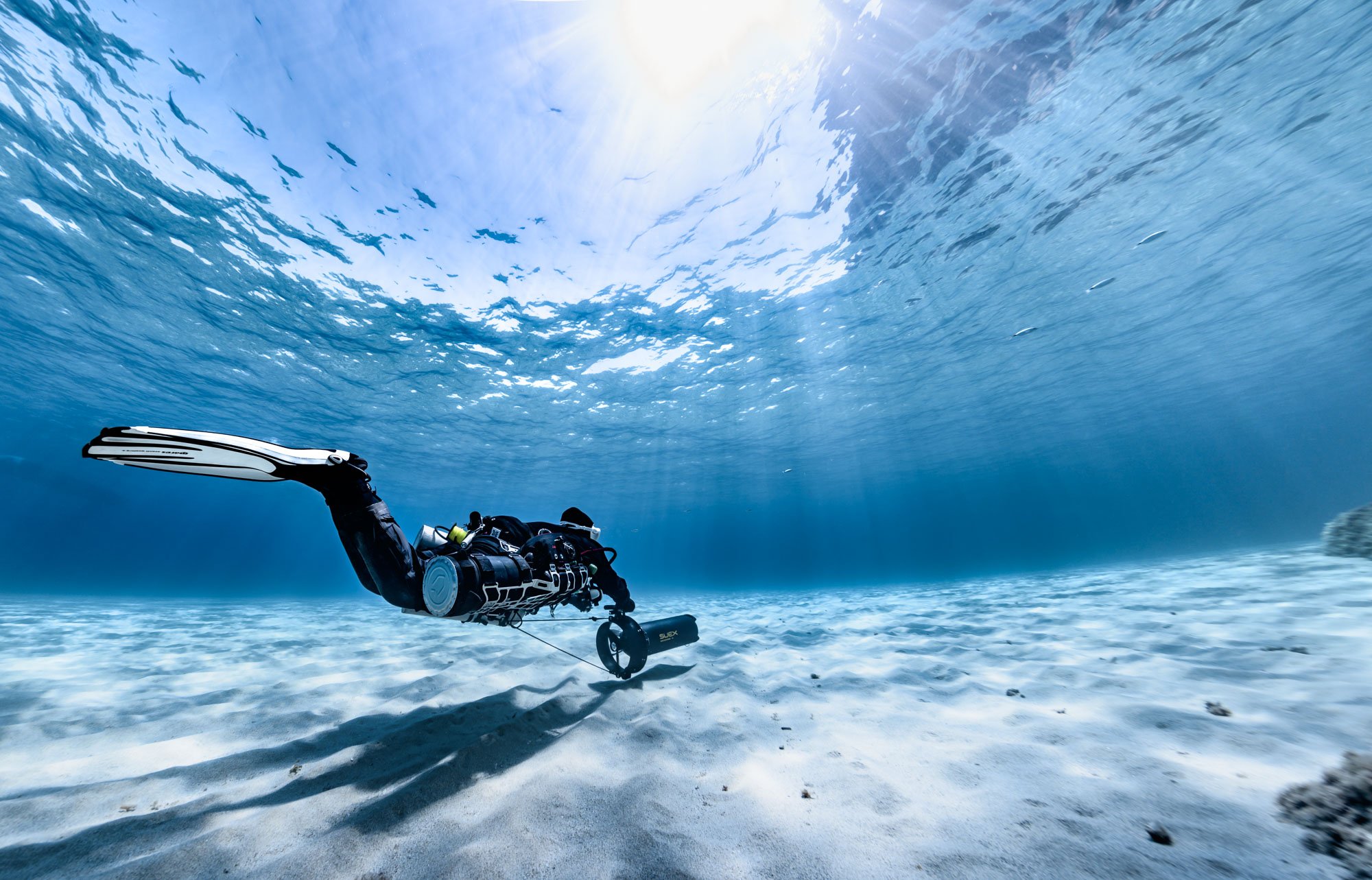

If you already dive trimix, you know the real challenge is not finding a gas that works. It is finding the gas that works for this dive. A mix can look good on one number and still be a poor choice once you check the others. That is why good trimix planning never stops at MOD alone. You also need to look at END, gas density, and the practical reality of how the dive will actually be conducted.
In our broader guides to technical dive planning, we already covered the bigger picture: team goals, exposure, gas management, bailout, and decompression. This article zooms in on one part of that process only: how to choose the right trimix for the planned depth without overcomplicating it. If you want the full planning framework, this piece is meant to complement it, not replace it.
What is trimix really solving?
Trimix is simply a breathing gas made from oxygen, nitrogen, and helium.
Divers add helium for two practical reasons. First, it reduces narcosis compared with a gas that contains more nitrogen. Second, because helium is much less dense than nitrogen, it can reduce breathing effort at depth.
That sounds simple enough. In practice, though, every trimix decision is a compromise.
Add too little helium, and the dive may stay within MOD while still feeling too narcotic or too “heavy” to breathe comfortably. Add too much helium, and the gas becomes more expensive, may complicate logistics, and can push you into a more hypoxic plan than the dive really needs. Good trimix planning is about balancing those trade-offs on purpose.
The three numbers that matter most
When divers ask, “How deep can you dive with trimix?”, the honest answer is: it depends on which limit you reach first.
MOD: your oxygen ceiling
MOD, or maximum operating depth, tells you how deep you can take a gas before the oxygen partial pressure reaches your chosen limit.
For open-circuit bottom gases, divers commonly plan around a working ppO₂ of 1.4 bar. For CCR diving, the MOD discussion is slightly different. Bailout and decompression gases are often checked against 1.6 bar, because the diver spends very little time at the maximum depth. Decompression gases on open circuit are also commonly planned to 1.6 bar to maximize the oxygen window during accelerated decompression. But when you are preparing a diluent for a rebreather, the goal is different again: the gas must still be able to dilute the loop at maximum depth. A practical rule is to choose a diluent whose ppO₂ at maximum depth is about 0.2 bar lower than the planned bottom setpoint, which is why values around 1.0 or 1.1 are common. Divesoft’s CCR guidance explicitly recommends setting diluent ppO₂ 0.2 bar below the planned setpoint at the greatest depth.
A common MOD formula in metric units for open-circuit gas planning is:
MOD = ((target ppO₂ / FO₂) - 1) × 10
So for a trimix with 18% oxygen:
MOD = ((1.4 / 0.18) - 1) × 10 = 67.8 m
That means Trimix 18/xx gives you a comfortable oxygen margin for a 60 m dive on open circuit, but MOD alone does not tell you whether the mix will feel clear-headed or easy to breathe. The OC examples below use this 1.4 bar assumption intentionally.
END: your narcotic depth
END, or equivalent narcotic depth, estimates how narcotic the gas will feel compared with breathing air at a shallower depth.
For years, divers argued about whether oxygen should count as narcotic in END calculations. That debate matters, because it changes the helium fraction you choose. The stronger current evidence points the other way: a 2022 EEG study by Vrijdag et al. found that hyperbaric oxygen did not produce the same narcotic EEG pattern as hyperbaric nitrogen and concluded that hyperbaric oxygen is not narcotic. For that reason, this article uses nitrogen-only END calculations.
Using that approach, a practical END formula in metric units is:
END = (((depth + 10) × FN₂) / 0.79) - 10
That formula does not tell you how you personally will react on a given day, but it is a useful planning benchmark. It gives you a consistent way to decide how much helium the dive really needs.
Why gas density changes the conversation
This is where trimix planning has evolved in recent years.
For a long time, divers focused mainly on MOD and END. Both still matter. But gas density adds another layer: it tells you how hard the gas may be to breathe at depth. Divesoft’s recent gas density article makes the point clearly: a mix can be acceptable on MOD and END and still be too dense from a physiological point of view. The article also argues that density does not replace MOD or END; it completes them.
That is an important shift. A diver may tolerate narcosis better than expected on one dive and worse on another. But breathing effort is not something you should leave to optimism. The same Divesoft article frames 5.2 g/L as a practical ceiling and points out why planning by density is often more robust than planning by END alone: lowering density by adding helium also makes END more conservative, but an “acceptable END” can still leave you breathing gas above 5.2 g/L.
In other words: planning by END alone can still leave you with a gas that is too dense.
A simple way to choose the right trimix
Instead of chasing one “perfect” mix, use a sequence.
1. Start with the maximum depth
Define the real working depth of the dive, not the optimistic one.
If the planned maximum depth is 60 m, calculate the oxygen fraction so the gas stays within your chosen ppO₂ limit at that depth. This sets the oxygen side of the equation first.
2. Choose your END target
Next, decide what END you want for the task at hand.
A decompression dive with a simple descent and straightforward bottom task may accept a different END than a complex cave segment, scooter run, wreck penetration, or high-stress bailout scenario. There is no benefit in pretending all 60 m dives have the same cognitive demand.
3. Check gas density
Now check the density.
This is the step many divers used to skip. It is also the step that often forces the most honest correction. A mix that “looks fine” on MOD and seems “good enough” on END may still be denser than you want.
4. Reality-check the plan
Before you approve the mix, ask practical questions:
Is the gas hypoxic at the surface?
Do you need a travel gas?
Does the helium cost make sense for the dive objective?
Does the mix fit the bailout strategy, team standardization, and available fills?
A technically elegant gas that makes the whole dive logistically messy is not automatically the best choice.
Worked example: planning a 60 m trimix dive
Let’s say your planned depth is 60 m and you are choosing an open-circuit bottom gas with a working ppO₂ of 1.4 bar.
Now compare three possible options.
Trimix 18/35
MOD: 67.8 m
END: about 31.6 m
Density: about 5.9 g/L
This mix clears the oxygen check, and on open circuit its 18% oxygen fraction is still reasonably efficient from a decompression point of view. But density remains above the 5.2 g/L reference, and the END is still relatively high for a demanding 60 m dive.
Trimix 18/45
MOD: 67.8 m
END: about 22.8 m
Density: about 5.2 g/L
This is much more balanced. Oxygen is still appropriate for the depth, END comes down significantly, and density moves into a much more defensible range. On open circuit, decompression efficiency stays similar to 18/35 because the oxygen fraction is the same, but the breathing and narcosis picture improves noticeably.
Trimix 15/55
MOD: 83.3 m
END: about 16.6 m
Density: about 4.5 g/L
From a density and END point of view, this is very comfortable. But now the gas is more hypoxic than the dive may require, and on open circuit that lower oxygen fraction usually means a longer decompression obligation for the same exposure. On CCR, that specific decompression penalty is much smaller because decompression is driven primarily by the maintained setpoint rather than the bottom gas FO₂ itself.
That is the whole point of trimix calculations: you are not trying to get the lowest END or the deepest MOD. You are trying to choose the most balanced gas for the entire dive.
The mistake divers make most often
The most common mistake is optimizing for only one number.
Some divers plan around MOD and stop there. The gas is breathable at depth, so they think the job is done. Others focus almost entirely on END and never check how dense the gas has become. Both approaches miss the bigger picture.
A better mindset is this:
MOD keeps oxygen exposure sensible. END keeps narcosis sensible. Gas density keeps breathing effort sensible.
Ignore one of those, and the plan becomes less robust.
Where dive planning tools actually fit in
A trimix dive computer is not there to replace planning. It is there to execute and monitor the plan underwater.
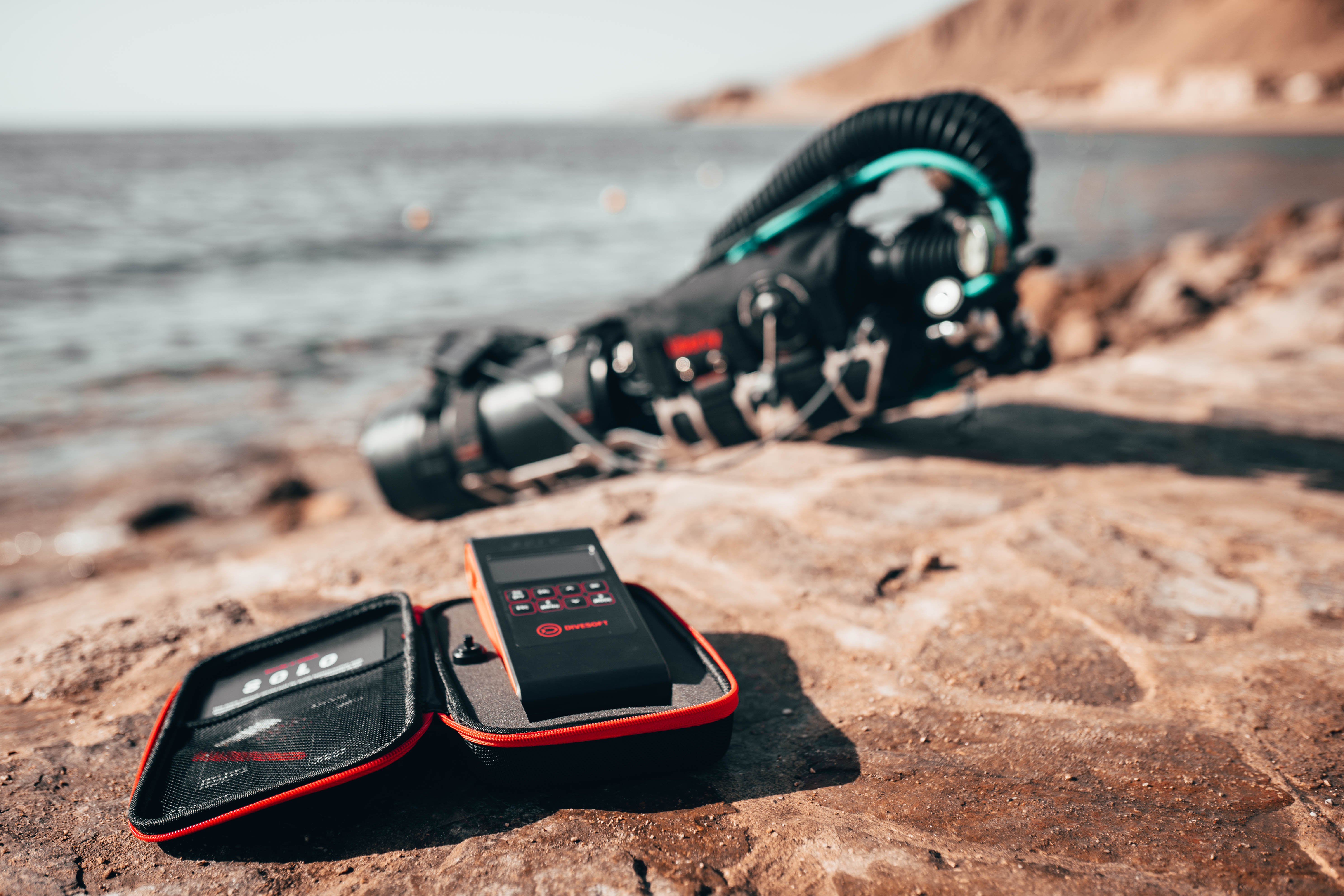
A trimix analyzer is not there to confirm what you intended to fill. It is there to verify what is actually in the cylinder.
That distinction matters.
Divesoft’s current ecosystem is well suited to that workflow. Divesoft.app currently includes a dive planner, gas planning, open-circuit, CCR, and bailout gas management, and the ability to convert plans to PDF for printing. On the gas-verification side, Divesoft’s analyzer range remains centered on oxygen and helium analysis for nitrox and trimix use.
So the practical workflow is straightforward:
Plan the dive.
Choose the gas.
Analyze the real mix.
Label the cylinder clearly.
Then dive the plan.
That sounds obvious, but many gas mistakes still happen because one of those steps is rushed or assumed.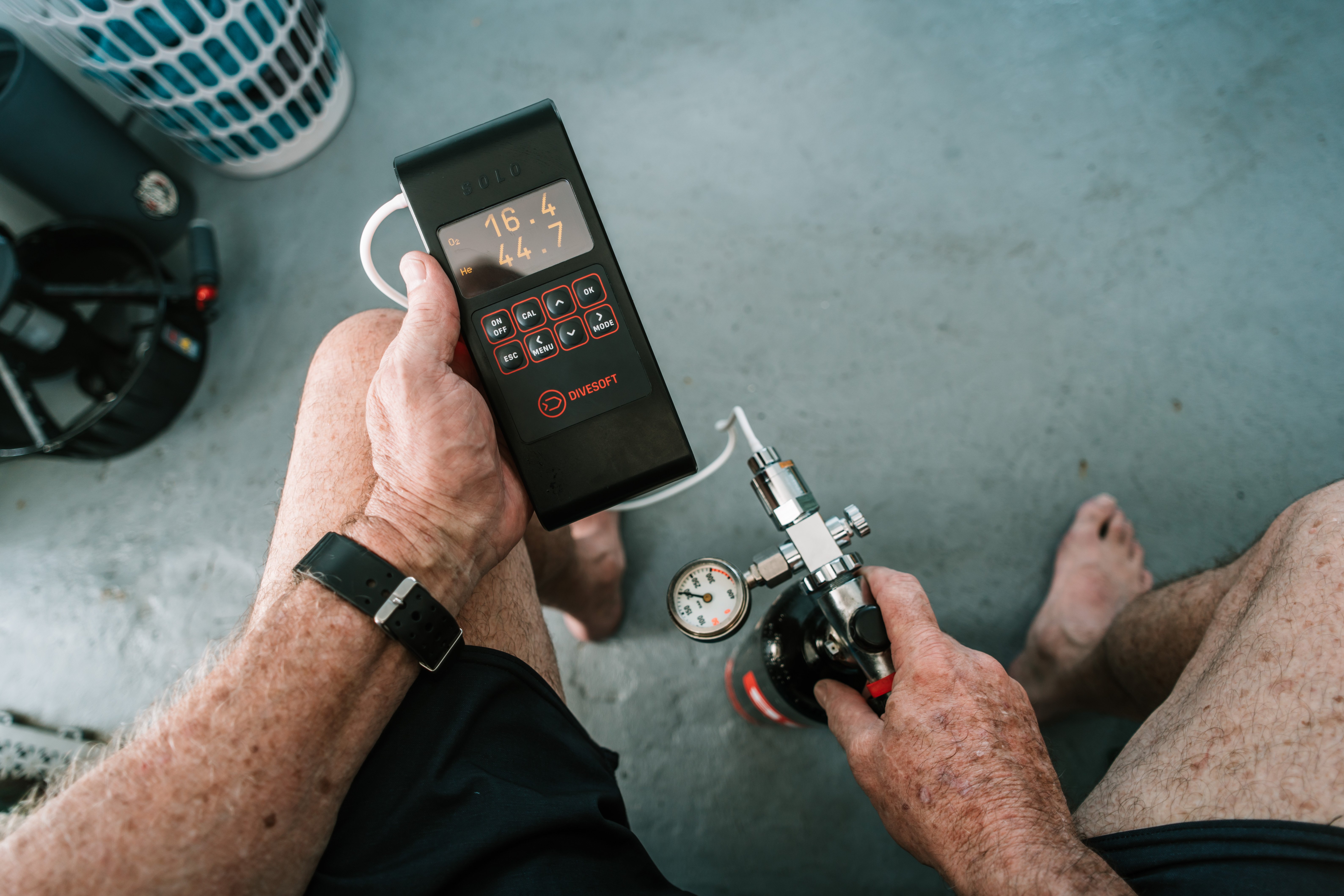
Labeling matters more than divers like to admit
A bad gas plan is sometimes a calculation problem. Just as often, it is a labeling problem.
That is why proper cylinder identification deserves more than a strip of tape and a fading marker. Divesoft recently added Label Print, which lets divers print adhesive gas labels directly from the He/O₂ analyzer or DNA analyzer. Divesoft’s current labeling page describes this as direct printing of professional-quality gas-mixture labels from the analyzer, and the new printer cable is designed specifically to connect the He/O₂ analyzer to a compatible label printer. In practice, that makes it much easier to create a clean, readable sticker with the analyzed mix, MOD, and the rest of the identification details your team requires.
That sounds like a small convenience. It is not. It closes the gap between the gas you planned, the gas you analyzed, and the gas you actually take into the water.
Common mistakes that are easy to avoid
A bad trimix plan is rarely the result of advanced mathematics. It is usually the result of skipping basics.
One frequent error is choosing a mix that looks acceptable for the target depth but leaves no margin when the actual depth runs slightly deeper than planned.
Another is underestimating how much breathing comfort matters. A gas that feels “workable” at the start of the dive may feel very different when workload, current, stress, cold, or task loading increase.
A third is trusting the fill label more than the analysis. Even the best plan fails if the cylinder contents are not what you think they are.
And finally, divers sometimes forget that a very elegant bottom gas may create a clumsy overall dive if travel gas, decompression gas, bailout, and team standardization were not considered at the same time.
A practical trimix checklist before the dive
Before you sign off on a mix, make sure you can answer yes to these questions:
That is not paperwork. That is risk reduction.
Final thought: stop asking for the “best” trimix
There is no universally best trimix. There is only the right trimix for a specific depth, task, team, and dive style.
If you want a simple rule to remember, use this one:
Do not choose a gas because one number looks good. Choose it because all three do.
That is what makes trimix planning safer. It is also what makes it calmer underwater.
For the broader planning context, link this article to A Comprehensive Guide to Technical Dive Planning / Part 1 and Part 2. For the density side of the discussion, also link to The 5.2 g/L Rule: Why Gas Density May Be the Most Important Number in Deep Diving. And if you want to reinforce the labeling workflow, the current Cylinder Labeling article is a natural related read.
Plan your next deep dive in Divesoft.app, verify the final mix with a Divesoft analyzer, and make sure the cylinder is labeled as clearly as the plan itself. That is where clean theory becomes